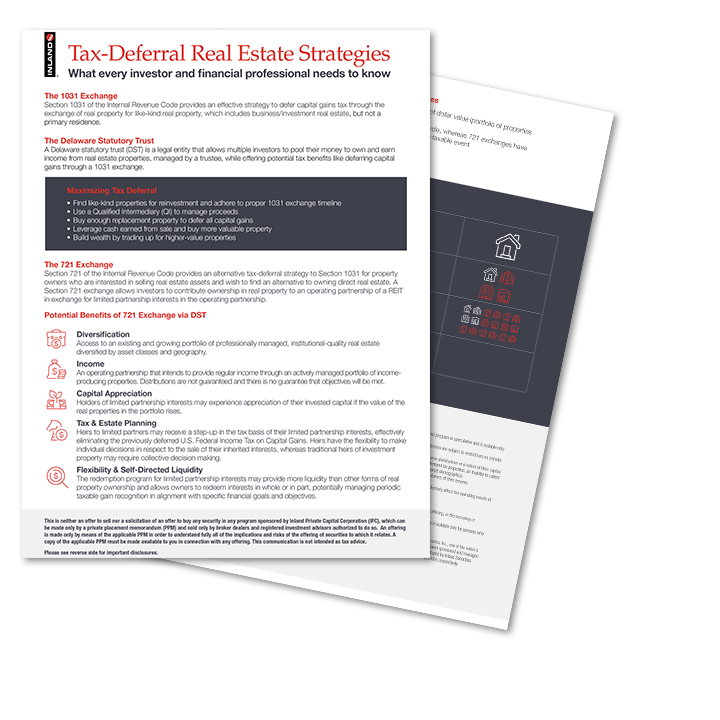
Delaware Statutory Trust (DST) Properties for 1031 Exchanges
This guide is the definitive resource for investors navigating the Delaware Statutory Trust (DST) landscape. Whether you are a veteran of multiple 1031 exchanges or an accredited investor looking for your first passive real estate exit, this deep dive provides the technical clarity and strategic insight you need.
What is a Delaware Statutory Trust (DST)?
To understand a Delaware Statutory Trust (DST), you have to look past the dense legal name and see it for what it truly is: a "strategic lifeboat" for real estate investors.
If you are currently facing the 45-day pressure of a 1031 exchange, or if you are simply tired of the "Three Ts" (Tenants, Toilets, and Trash), the DST is a legal entity that allows you to own a fractional interest in high-quality, institutional real estate. Instead of owning 100% of a stressful rental house, you might own a small percentage of a $50 million Amazon distribution center or a Class-A apartment complex in a high-growth market.
The IRS "Green Light"
The most important date in the history of DSTs is August 16, 2004. That is when the IRS issued Revenue Ruling 2004-86, which officially recognized the DST as a valid vehicle for a 1031 exchange.
This ruling changed the 1031 exchange game. It confirmed that the IRS views owning a "beneficial interest" in a DST the same way it views owning the actual bricks and mortar of a property you manage yourself. This "look-through" tax treatment allows you to defer your capital gains taxes and depreciation recapture while moving into a position of total passivity.
How It Functions: The Fractional Model
In a DST structure, a professional real estate firm (the Sponsor) identifies, performs due diligence on, and acquires a large property. They then "syndicate" that property to multiple investors.
The Master Tenant: Because the IRS requires DSTs to be passive, the Sponsor sets up a "Master Tenant" structure. This ensures you, as the investor, aren't the one signing leases or fixing leaky pipes.
Undivided Interest: You own an "undivided fractional interest" in the entire asset. If the DST owns a 300-unit building and you own 1%, you don't own 3 specific units; you own 1% of the income and 1% of the appreciation for all 300 units.
Jerry Baker’s Insight: I often describe a DST as "institutional real estate in a pre-packaged box." All the hard work, the debt, the management, and the vetting are done before you ever see the deal. You simply wire the funds to cross the 1031 exchange finish line.
Key Characteristics of a 1031-Compliant DST
To keep the IRS happy, a DST must adhere to a rigid set of rules known as the "Seven Deadly Sins." These restrictions prevent the trust from being reclassified as a business entity (which would disqualify your 1031 tax deferral). For instance:
No new capital: You cannot put more money into the trust after it closes.
No refinancing: The Sponsor cannot renegotiate the mortgage terms.
No new leases: The Sponsor cannot enter into new leases (with some emergency exceptions).
While these rules sound restrictive, they are actually designed to protect your tax-deferred status by ensuring the investment remains truly passive, exactly what a 1031 exchange replacement property is meant to be.
What types of properties are DSTs?
One of the most common misconceptions about Delaware Statutory Trusts is that they are a "niche" product for small-scale investors. In reality, DSTs provide a seat at the table with some of the largest institutional owners in the world. When you invest in a DST, you aren't looking at "fixer-uppers" or local retail strips; you are acquiring a fractional interest in institutional-grade assets that were previously the exclusive playground of pension funds and multi-billion-dollar insurance companies.
Asset Classes: The Core Four and Beyond
DST properties generally fall into four primary "core" categories, along with specialized niche sectors that offer defensive growth.
Multifamily (Apartments): This is the "king" of the DST market, often representing 35-45% of available inventory. In 2026, sponsors are focusing heavily on Class-A garden-style communities in the Sunbelt and Workforce Housing in suburban growth hubs. These properties typically feature hundreds of units, offering a natural hedge against vacancy—if one tenant moves out, you still have 299 others paying rent.
Industrial & Logistics: With the continued dominance of e-commerce, these are among the most sought-after DST assets. You’ll frequently see large Amazon fulfillment centers or FedEx distribution hubs. These often carry "mission-critical" status for the tenant, meaning they are unlikely to vacate even in a down economy.
Necessity Retail: Forget the shopping mall. DST retail is built around "Essential Services." Think single-tenant NNN properties occupied by brands like Kroger, Costco, or Dollar General, or neighborhood centers anchored by a high-traffic grocery store.
Medical Office Buildings (MOB): As the population ages, medical office space has become a "recession-resistant" darling of the DST world. These properties are often leased by large hospital systems or dialysis providers like DaVita or Fresenius, with long-term lease structures and incredibly high tenant retention.
Niche Asset Classes: You will also find institutional offerings in Self-Storage portfolios, Senior Housing, and Student Housing near major Tier-1 universities.
Strategic Locations: Following the Migration
Sponsors don't just pick properties at random; they follow the data. In 2026, the geographic "center of gravity" for DSTs has shifted toward markets with favorable tax environments and robust job creation.
The Sunbelt Expansion: Florida, Texas, the Carolinas, and Arizona are frequent targets for multifamily and industrial DSTs. These regions are seeing sustained in-migration, which supports consistent rent growth.
Secondary Growth Hubs: Markets like Nashville, Charlotte, and Salt Lake City are highly prized for their balance of lifestyle appeal and employment stability.
Gateway Diversification: While "gateway" cities like New York or Boston are still featured, sponsors are often cherry-picking "Trophy" assets in these locations that offer long-term stability rather than high-octane growth.
Lease Terms: Stability by Design
The "Seven Deadly Sins" mentioned previously mean that a DST cannot constantly churn tenants. Therefore, sponsors prioritize Long-Term Leases to ensure income stability for the life of the trust.
Weighted Average Lease Term (WALT): This is a critical metric you'll find in a DST's Private Placement Memorandum (PPM). A high WALT (e.g., 7–12 years) is common for retail and industrial offerings, ensuring the rent roll is secured for years to come.
Tenant Credit Quality: Because the investment is passive, the "legal teeth" of the lease matter. Sponsors target Investment-Grade Tenants (S&P rated BBB- or higher) whose corporate balance sheets back the monthly rent checks.
Jerry Baker’s Insight: Don't get blinded by a high "teaser" yield. In 2026, the quality of the tenant is your true insurance policy. I'd rather see a 4.5% distribution backed by a 15-year FedEx lease than a 7% yield from a local gym that might not exist in three years.
DST Ownership, Rights, and Responsibilities
One of the most important things for a 1031 investor to wrap their head around is that while you are no longer the "landlord," you are still a property owner. The Delaware Statutory Trust is not a corporation or a partnership; it is a trust that holds legal title to the real estate, and you hold a Beneficial Interest.
This distinction is what allows the IRS to "look through" the trust and treat your investment as a direct ownership of real estate.
Your Rights as a DST Investor
Because a DST is a passive investment, your rights are different than they would be with a deeded NNN property.
Pro-Rata Share: You are entitled to your exact percentage share of everything the property produces—income, tax write-offs, and net sale proceeds.
Non-Recourse Protection: This is a major win for sophisticated investors. The debt in a DST is "non-recourse" to the individual investor. The lender cannot come after your personal assets, your home, or your other investments if the property fails. They only have a claim to the asset itself.
Information Rights: You receive regular reporting, institutional-level accounting, and annual tax documents (typically a substitute 1099 or Schedule K-1).
The Sponsor’s Responsibilities: The "Active" Half of the Passive Deal
If you are passive, who is active? The Sponsor. This is the firm that manages the entire lifecycle of the investment. Their job includes:
Asset Management: Overseeing property managers, handling leasing, and ensuring the property is physically maintained.
Lender Compliance: Managing the mortgage payments and reporting to the bank.
Strategic Execution: Deciding when the market is "right" to sell the property and return capital to investors.
How Income Works: The Monthly Distribution
Most DSTs are designed to provide stable, predictable cash flow.
Distributions: Rent is collected from tenants, expenses and debt service are paid, and the remaining cash is distributed to you monthly.
Current Yield: This is often referred to as the "Cash-on-Cash" return. In 2026, many institutional DSTs target distributions in the 5% to 7% range, depending on the asset class and amount of leverage (debt) used.
The Power of Tax Benefits: Depreciation and Shelter
This is the area where DSTs truly shine for high-net-worth individuals. Because you are a "beneficial owner," the tax benefits of the real estate flow directly to you.
Depreciation: Even though the property is professionally managed, you still get to claim your share of depreciation. This "paper loss" can often shelter a significant portion of your monthly distributions. In many cases, an investor might receive a 5% cash return, but only pay taxes on 2% or 3% of it.
Interest Deductions: Your pro-rata share of the interest paid on the DST's mortgage is also deductible on your personal return.
Pass-Through Treatment: There is no "double taxation" like there is with a C-Corp. The income flows through to you, and the tax attributes (losses and income) are reported on your personal return.
Jerry Baker’s Insight: I often see investors focus entirely on the "yield" and forget the "tax-equivalent yield." A 5% distribution from a DST is often worth more than 6% from a standard dividend stock because so much of that DST income is sheltered by depreciation. Always look at the net that stays in your pocket.
Value Appreciation and The Exit
While monthly income is great, the "wealth multiplier" in a DST is the appreciation.
Market Growth: If the Sponsor manages the asset well and the local market grows, the property increases in value.
The Sale: When the Sponsor decides to sell (usually 5–10 years in), the debt is paid off, and the remaining proceeds are distributed to you.
Exit Types: You then face a "fork in the road." You can either do another 1031 exchange into a new DST/Property, or if the Sponsor has structured it as a 721 Exchange, you can "roll" into a diversified REIT.
The Exit: Traditional Sale vs. The 721 Exchange
The "Exit Strategy" is the moment of truth for any DST investment. When you enter a DST, you are generally committing to a 5- to 10-year holding period. However, the way you get your money back isn't always a simple "check in the mail." In 2026, two primary exit paths dominate the institutional landscape.
The Traditional Cash Sale
This is the standard lifecycle event. The Sponsor determines that the property has reached its maximum value or that the market cycle is at a peak. They sell the asset to a third-party buyer (often another institutional fund or a REIT).
The Payout: The mortgage is paid off, and you receive your pro-rata share of the net proceeds.
The Choice: You are now at a "tax fork in the road." You can either pay the capital gains and depreciation recapture taxes or, as most of my clients do, re-engage your Qualified Intermediary (QI) to perform another 1031 exchange into a fresh DST or a deeded NNN property.
The 721 Exchange (The UPREIT Exit)
For many sophisticated investors, the goal isn't just tax deferral; it's ultimate diversification. Under IRC Section 721, certain Sponsors structure their DSTs with a "721 Option."
Instead of selling the property to a stranger, the Sponsor’s affiliated REIT acquires the entire property from the trust. In exchange for your "beneficial interest" in the building, you receive Operating Partnership (OP) units in the REIT.
How 721 Valuations Work
One of the most frequent questions I get is: "How do I know I’m getting a fair deal if the Sponsor is both the buyer and the seller?"
The FMV Option: The conversion is based on the Fair Market Value (FMV) of the property at the time of the roll-up. Sponsors typically engage independent, third-party appraisers (like CBRE or Cushman & Wakefield) to set this value.
Economic Equivalence: Your OP Units are mathematically tied to the Net Asset Value (NAV) of the REIT. If you had $1 million in DST equity and the REIT's share price is $25, you would receive 40,000 OP units.
Jerry Baker’s Insight: The 721 exchange is the "Hotel California" of real estate; you can check in via a 1031, but you can never 1031 out. Once you move into OP units, you have effectively exited the 1031 cycle. While you gain massive diversification and potential quarterly liquidity, your future sales will be taxable.
The Players: Who is involved?
Investing in a Delaware Statutory Trust (DST) is not a solo mission; it is a coordinated entry into a pre-arranged ecosystem of institutional professional entities. To the investor, the DST appears as a "turnkey" package, but behind that package is a complex machinery of specialists who ensure the property meets IRS guidelines, lender requirements, and financial benchmarks.
Understanding these roles is vital because, as a passive investor, your success depends entirely on the integrity and skill of these parties.
The Sponsor: The Mastermind and Manager
The Sponsor is the engine of the DST. Usually, a large, national real estate firm (such as Inland, ExchangeRight, or Passco), the Sponsor is responsible for the entire lifecycle of the investment.
Acquisition & Due Diligence: The Sponsor identifies the property and uses its own capital to tie it up. They conduct "institutional-grade" vetting—everything from structural inspections to environmental reports—before an investor ever sees the deal.
Asset Management: Once the DST is closed to new investors, the Sponsor oversees the long-term strategy. They aren't just "collecting rent"; they are managing the property managers, monitoring market trends, and ensuring the asset remains stabilized.
The Exit Strategist: The Sponsor decides when to sell. They monitor cap rate trends and property performance to determine the optimal "full-cycle" moment to liquidate and return equity to you.
The Lender: Providing the Non-Recourse Advantage
Most DSTs come with "built-in" financing from institutional lenders like Fannie Mae, Freddie Mac, or major national banks.
Assumption, Not Application: In a traditional property purchase, you spend weeks providing tax returns to a bank. In a DST, the loan is already in place. You simply "assume" your pro-rata share of that debt.
Non-Recourse Structure: This is a major risk-mitigation feature. Because the debt is non-recourse to the investor, the lender cannot come after your personal assets (your home, car, or other savings) if the property fails. Their only recourse is the real estate itself.
The Master Tenant: Your IRS Compliance Shield
Under IRS Revenue Ruling 2004-86, a DST must remain purely passive to qualify for 1031 treatment. To satisfy this, Sponsors create a Master Tenant (typically an affiliate of the Sponsor).
The Operational "Buffer": The Master Tenant leases the entire property from the DST trust. They then sublease individual units to actual residential or commercial tenants.
Daily Execution: The Master Tenant is empowered to sign new leases, handle repairs, and manage the day-to-day "messy" parts of real estate. By keeping this active management inside the Master Tenant entity, the DST trust itself stays legally "passive," protecting your tax-deferred status.
Jerry Baker’s Insight: The Master Tenant is essentially the legal "firewall" between you and the IRS. Without this structure, the IRS could claim you are "running a business" rather than "holding an investment," which would trigger a massive tax bill.
The Broker-Dealer & Registered Representative
Because a DST interest is legally classified as a security, it cannot be sold by a regular real estate agent. It must be offered through a FINRA-registered Broker-Dealer.
Second-Tier Vetting: The Broker-Dealer performs a "due diligence" check on the Sponsor and the property. They review the Private Placement Memorandum (PPM) to ensure the projections are grounded in reality and that the Sponsor’s track record is legitimate.
Suitability: Your Registered Representative (your advisor) is legally required to ensure the DST is a "suitable" investment for your specific financial goals and risk tolerance.
The Qualified Intermediary (QI): The Money Mover
If you are coming into a DST via a 1031 exchange, the Qualified Intermediary (QI) is the final, essential player.
Constructive Receipt: To defer taxes, you can never touch your sale proceeds. The QI holds your funds in escrow and wires them directly to the DST Sponsor at closing.
Timeline Tracking: The QI ensures you identify your DST replacement properties within the strict 45-day window and close within 180 days.
Benefits of DST Properties
When most investors hear about Delaware Statutory Trusts, they focus solely on the 1031 exchange aspect. While tax deferral is the engine that drives this vehicle, it’s far from the only advantage. When you move into a DST, you are essentially upgrading from a "mom-and-pop" management style to a sophisticated, institutional wealth-preservation strategy.
Here is a breakdown of why DSTs have become the go-to solution for high-net-worth investors in 2026.
100% Tax Deferral: Stopping the "Tax Triple-Play"
The most immediate benefit is the ability to defer the "Big Three" taxes that usually eat up 25% to 40% of a property sale. By exchanging into a DST, you aren't just pushing off Federal Capital Gains; you are also deferring the 3.8% Net Investment Income Tax (NIIT) and, perhaps most importantly, the Depreciation Recapture tax.
In many cases, depreciation recapture is the silent killer of a real estate exit. A DST allows you to roll that entire liability forward, keeping your equity working for you rather than sending a massive check to the IRS.
The Estate Planning "Holy Grail": The Step-Up in Basis
For many of the families I advise, the goal isn't just to save taxes today—it's to build a generational legacy. DSTs are arguably the most effective tool for this. Because you hold a beneficial interest in real property, your heirs receive a "step-up in basis" upon your passing.
This means the IRS resets the value of the investment to the Fair Market Value at the date of death. Your heirs can potentially sell the DST interest and walk away with the cash, having erased decades of deferred capital gains and depreciation taxes. It is the ultimate "swap 'til you drop" strategy.
Closing Velocity: Your 1031 Insurance Policy
The 1031 exchange clock is unforgiving. You have 45 days to identify and 180 days to close. If your traditional "bricks and mortar" deal falls through on day 40 because of a bad inspection or a fickle seller, you are in a crisis.
DSTs offer Closing Velocity. Because these offerings are "pre-packaged" (the Sponsor has already closed on the property and put the debt in place), you can complete your subscription in as little as 48 to 72 hours. I often see investors use a DST as a "backup" or "ID insurance" to ensure they don't get stuck with a massive tax bill if their primary deal fails.
Debt Matching: Clean Compliance Without the Bank
The IRS requires you to replace the value of the property you sold and the amount of debt you held on it. Finding a property that perfectly matches your debt-to-equity needs is a logistical nightmare.
DSTs solve this through built-in, non-recourse leverage. If you need to replace $500,000 in debt, you can simply select a DST with a 50% Loan-to-Value (LTV) ratio. You satisfy the IRS requirement without ever having to fill out a loan application or sign a personal guarantee. The debt is already baked into the structure.
Jerry Baker’s Insight: This is the "secret sauce" for older investors. You get the tax benefits of leverage without the "hair-graying" stress of being personally liable for a multi-million dollar mortgage. If the property hits a rough patch, the lender can’t come after your other assets.
Lower Minimums and Diversification
In the traditional market, $1 million might buy you one decent retail building or a small apartment complex. In the DST world, that same $1 million can be spread across five different institutional assets—an Amazon warehouse in Texas, a medical clinic in Florida, and a Class-A apartment hub in the Carolinas.
With minimum investments often starting at $100,000, you can build a diversified portfolio that is geographically spread out and hedged across multiple asset classes. This moves your risk away from a "single point of failure" and into a stabilized institutional environment.
Use Cases: Beyond the Simple Exchange
A Delaware Statutory Trust isn’t just a "backup plan"—it is a precision instrument for wealth management. While the most common reason to enter a DST is to satisfy a 1031 exchange, sophisticated investors use them to solve a variety of complex financial puzzles. In 2026, we are seeing four primary scenarios where a DST outperforms traditional direct ownership.
The Retirement Exit: Trading "Sweat Equity" for "Mailbox Money"
The most common use case I see involves the retiring landlord. You have spent 30 years managing a portfolio of duplexes or small commercial buildings. Your equity has grown, but so have your headaches.
By exchanging into a DST, you effectively "retire" from the active management of real estate without triggering the massive tax bill that usually accompanies a retirement sale.
The Benefit: You move into institutional-grade assets with professional management.
Maximizing the Strategy: Aim for a "stabilized" DST—like a multifamily or medical office building—that prioritizes consistent monthly distributions over aggressive value-add growth. This ensures your retirement lifestyle is backed by predictable cash flow.
The Estate Planning "Equalizer"
Leaving a single apartment building to three children is often a recipe for a family dispute. One child wants to sell, one wants to refinance, and the third wants to manage the property.
DSTs solve this through fractional divisibility.
The Benefit: You can divide your 1031 equity into three separate DST interests. Upon your passing, each heir inherits their specific share with a stepped-up basis (per IRC Section 1014).
Maximizing the Strategy: Heirs can make their own "full-cycle" decisions. One child can sell and take the cash (paying no capital gains due to the step-up), while another can 1031 into a new DST to keep the legacy growing.
The "Mop-Up" Boot Strategy
In a 1031 exchange, you must reinvest 100% of your net proceeds to avoid paying taxes on the "boot" (the leftover cash). Often, an investor finds a perfect replacement property for $900,000 but sold their original for $1 million. That leftover $100,000 is taxable "boot."
The Benefit: Because DSTs have incredibly low minimums (often as low as $25,000 or $50,000 for "mop-up" cases), you can use the DST as a tax-deferral catch-all.
Maximizing the Strategy: Tell your Qualified Intermediary (QI) to wire the exact remaining balance of your exchange funds to a DST sponsor. This ensures your exchange is 100% tax-deferred, down to the last dollar.
Geographic and Asset Class Diversification
If 100% of your real estate wealth is tied up in one office building in a single city, you are highly exposed to localized economic downturns.
The Benefit: A DST allows you to spread that same equity across multiple states and asset classes simultaneously.
Maximizing the Strategy: Use the "200% Rule" during your 45-day identification period to name a diversified "basket" of DSTs. For example, you could identify a multifamily project in Florida, an industrial hub in Texas, and a medical clinic in North Carolina. This "hedged" approach protects your principal from regional volatility.
Jerry Baker’s Insight: I frequently have clients who use the "ID Insurance" use case. They are 100% committed to buying a specific NNN building, but they identify a DST as their #3 option. If the building's inspection fails on day 44, they don't panic—they just pivot to the DST and save the exchange. It’s the ultimate sleep-at-night insurance.
The Risks of DST Investments
Delaware Statutory Trusts are powerful, but they are not "risk-free." In the specialized world of 1031 exchanges, the very features that make DSTs attractive (like passivity and IRS compliance) are the same ones that create their biggest drawbacks.
Before you commit your equity, you need to understand the "trade-offs" involved.
The "Seven Deadly Sins" and the Cost of Compliance
To maintain their status as "like-kind" real estate under IRS Revenue Ruling 2004-86, DSTs must adhere to seven rigid operational restrictions. While these rules protect your tax deferral, they significantly limit the Sponsor’s flexibility in a crisis.
No New Capital: If a major storm hits an apartment complex and insurance doesn't cover everything, the Sponsor cannot "call" for more money from investors. They must rely entirely on pre-funded cash reserves.
No Refinancing: The Sponsor cannot renegotiate the mortgage. If interest rates drop, you can’t refinance to a lower rate. Worse, if the loan matures during a market downturn, the Sponsor may be forced to sell the property at a bad time because they cannot extend the debt.
No New Leases: The Sponsor generally cannot enter into new leases (unless a tenant defaults). This is why most DSTs focus on stable, long-term assets rather than "turnaround" projects.
Total Lack of Control: The Passenger Seat
For many of my clients who are used to being "the boss" of their own buildings, this is the hardest pill to swallow. In a DST, you are 100% a passive passenger.
No Voting Rights: You cannot fire the property manager, you cannot vote on whether to sell the building, and you cannot influence how much is kept in reserves.
Reliance on the Sponsor: Your entire investment is a bet on the Sponsor's competence. If they mismanage the asset or make a poor market timing decision, you have no legal recourse to intervene.
Illiquidity: The "Seven-Year Lock-In"
A DST interest is not a stock. There is no public exchange where you can "sell" your share if you suddenly need cash.
No Secondary Market: While it is technically possible to sell your beneficial interest privately, it is incredibly difficult and almost always results in a massive "haircut" (discount) to your principal.
Holding Period: You are committed for the life of the trust—usually 5 to 10 years. If your personal financial situation changes in year three, your capital is likely still locked in that Amazon warehouse or apartment complex until the Sponsor exits.
Market and Principal Risk
At the end of the day, a DST is real estate. It is subject to the same cyclical forces as any other building.
Vacancy and Income: Monthly distributions are never guaranteed. If a major tenant in an industrial DST goes bankrupt, your "mailbox money" could stop overnight.
Principal Loss: There is no guarantee you will get back 100% of your initial investment. If property values in a specific region drop by 20% over your holding period, you will realize that loss at the time of sale.
Jerry Baker’s Insight: Don't let the phrase "Institutional Grade" lull you into a false sense of security. Even the best building in the world can lose value if the Sponsor over-leveraged the deal or if the local economy shifts. This is why Sponsor Track Record is the single most important part of your due diligence.
Deep Dive into the PPM
If you are serious about a Delaware Statutory Trust, you have to get comfortable with the Private Placement Memorandum (PPM). This isn't just a marketing brochure; it is a legally binding disclosure document that can often exceed 150 pages. While it’s tempting to skip to the "Estimated Returns" page, the PPM is where the "fine print" lives—it's where the risks are laid bare and the fees are quantified.
In my experience, investors who master the PPM are the ones who avoid "blown" exchanges and underperforming assets. Here are the four critical sections you need to deconstruct before you wire a single dollar.
The Master Lease: The Operational "Engine"
Because a DST must remain passive to satisfy the IRS, the Master Lease is the most important legal bridge in the document. It details the relationship between the Trust (which you own a piece of) and the Master Tenant (an affiliate of the Sponsor).
Why it matters: The Master Tenant is responsible for the actual "dirty work"—hiring property managers, signing individual unit leases, and maintaining the building.
What to look for: Check how the rent flows. Is there a "base rent" that covers the mortgage, and then a "bonus rent" that flows to you? Understanding this "waterfall" ensures you know exactly how your monthly check is calculated and what happens if occupancy dips.
Risk Factors: The "What If" Catalog
This is usually 20 to 30 pages of "everything that could go wrong." Most investors gloss over this, assuming it’s just legal boilerplate. Don't make that mistake.
Why it matters: This section specifically identifies market-specific, property-specific, and sponsor-specific risks.
What to look for: Look for risks related to tenant concentration (e.g., "What happens if our anchor tenant, Walgreens, closes this specific location?") and interest rate risk if the debt is not fixed for the entire hold period. If you see a risk that makes you lose sleep, it’s a sign that specific DST isn't a fit for your risk tolerance.
Anticipated Distributions: Pro-Forma vs. Reality
This is where the Sponsor projects your monthly income. It’s important to remember that these are projections, not guarantees.
Why it matters: You need to know if the Sponsor is being realistic or "polishing" the numbers to attract capital.
What to look for: Compare the "Pro-forma" (projected) numbers against the property's historical performance. If the Sponsor is projecting 5% rent growth in a market that has historically averaged 2%, you need to ask why. Also, look at the Reserves—does the PPM set aside enough cash for unexpected repairs? A DST cannot do "capital calls," so if the reserves are thin, your distributions are the first thing to get cut when a roof leaks.
Fees: Understanding the "Upfront Load"
DSTs are institutional-grade products, and they come with institutional-grade costs. In the PPM, you’ll find a section called "Estimated Use of Proceeds." This is where you see the upfront load—the total cost of setting up the deal.
Why it matters: This load typically ranges from 6% to 8% of the equity. This covers things like broker-dealer commissions, legal fees, and the Sponsor's acquisition fee.
What to look for: I always tell my clients to look at the "Asset Management Fee" and the "Disposition Fee." A Sponsor should be incentivized to perform. If the fees are too high upfront, they might not be as motivated to knock it out of the park during the 5–10 year hold period.
The Process: Step-by-Step
One of the greatest stressors in a 1031 exchange is the clock. The IRS gives you 45 days to identify and 180 days to close, and those deadlines are absolute—missing them by even a few minutes can trigger a massive tax bill.
Because DSTs are "pre-packaged," the process is significantly more streamlined than a traditional real estate closing. However, you still need a precise flight plan. Here is the exact, step-by-step timeline from the moment you sell your "relinquished" property to the day you receive your first DST distribution check.
Step 1: The Relinquished Property Sale
The process officially begins when you close on the sale of your current investment property.
The Key Action: You must have a Qualified Intermediary (QI) in place before you close. The sale proceeds must go directly from the closing table to the QI’s escrow account. If you touch the money, the exchange is void.
Step 2: Consultation and Inventory Review (Days 1–30)
As soon as you close, we sit down to look at the current DST market.
The Key Action: We look at your equity amount and the debt you need to replace. I’ll present a "menu" of institutional options—multifamily, industrial, or NNN retail—based on what fits your income needs.
Jerry Baker’s Insight: Don't wait until Day 40 to start looking. DST inventory moves fast. If a high-quality "recession-resistant" medical DST opens up on Day 10, we want to be ready to reserve your spot before it fills up.
Step 3: The Identification Period (Day 45 Deadline)
This is the most critical hurdle. You must formally notify your QI of the properties you intend to buy.
The Key Action: You’ll fill out an identification form listing the specific DSTs. Most investors use the "Three-Property Rule" or the "200% Rule." * The Safety Net: I always recommend identifying at least one "backup" DST just in case your primary choice reaches capacity before you fund.
Step 4: Subscription and Due Diligence
Once you’ve made your selection, you’ll receive the Subscription Booklet.
The Key Action: You (and your legal/tax team) will review the PPM we discussed in Section 11. You’ll sign the investor questionnaire and the signature pages. This is where you verify your status as an Accredited Investor.
Step 5: Funding the Exchange
With the paperwork signed, it’s time to move the capital.
The Key Action: Your QI wires the funds directly to the DST Sponsor’s escrow account. Because the property is already owned by the Trust, there are no "inspections" or "appraisals" for you to wait on—those were done by the Sponsor months ago.
Step 6: Closing and Confirmation (Day 180 Deadline)
The Sponsor confirms receipt of your funds and issues your Certificate of Beneficial Interest.
The Key Action: You are now officially an owner. Your QI will provide the final accounting for your tax records. While the IRS gives you 180 days, most DST exchanges close within 5 to 10 days of identification.
Step 7: The First Distribution
Real estate is about results. Within 30 to 60 days of closing, you should see the first fruits of your investment.
The Result: Your share of the rental income is distributed, typically via ACH direct deposit. You’ll also receive regular asset management reports so you can track how your "Amazon hub" or "apartment community" is performing in real-time
NNN DST Investments FAQ
In the world of tax-deferred exchanges, there is no such thing as a "simple" question. Because DSTs involve the intersection of federal tax law, securities regulations, and high-stakes real estate, investors often have the same "burning" concerns. Here are the answers to the most frequent questions I hear in my private consultations.
-
Theoretically, yes, but practically, no. A DST interest is a long-term, illiquid investment. There is no public secondary market like the New York Stock Exchange. While you can sell your interest to another accredited investor via a private party transaction, it is difficult to find a buyer, requires Sponsor approval, and usually involves a significant "liquidity discount" (selling for less than the current market value). You should enter a DST with the intention of holding until the Sponsor sells the entire asset.
-
Yes, but only through a Self-Directed IRA (SDIRA). However, there is a strategic catch: 1031 exchanges are designed to defer taxes on taxable real estate. Since your IRA is already a tax-advantaged vehicle, you don’t need the 1031 deferral. Most of my clients use DSTs for their personal, non-retirement equity to solve tax problems, while using their IRAs for other types of private placements.
-
This is where the Master Tenant structure earns its keep. Because of the "Seven Deadly Sins," the Trust itself is restricted, but the Master Tenant affiliate has the power to sign a new lease or renegotiate with a new occupant. Furthermore, most institutional DSTs maintain a Cash Reserve Account specifically to cover debt service and basic maintenance during a vacancy, protecting your investment from immediate foreclosure.
-
No. Like any real estate investment, distributions are based on the property’s actual performance. If expenses rise or occupancy drops, your monthly check could decrease. This is why we prioritize "Necessity Retail" and "Class-A Multifamily"—sectors that historically maintain high occupancy even in recessionary cycles.
NNN DST Investments Terms Glossary
Accredited Investor: An individual meeting SEC Rule 501 criteria, typically a net worth of $1M+ (excluding primary home) or consistent annual income of $200k+.
Beneficial Interest: The specific legal form of ownership in a DST, granting the holder a pro-rata share of all income, tax benefits, and sale proceeds.
Cash-on-Cash (CoC) Return: The annual pre-tax cash flow divided by the total amount of equity invested.
Constructive Receipt: An IRS concept where an investor is taxed because they gained "control" of their exchange funds. Using a Qualified Intermediary (QI) prevents this.
Full Cycle: The complete investment period of a DST, from the initial acquisition by the Sponsor to the final sale of the asset.
Loan-to-Value (LTV): The ratio of the mortgage amount to the appraised value of the property. Most DSTs feature 40% to 60% LTV.
Non-Recourse Debt: A loan that is secured by the property itself. The lender cannot pursue the individual DST investors for a deficiency judgment.
Private Placement Memorandum (PPM): The formal legal document provided to prospective investors that discloses the structure, risks, fees, and strategy of the offering.
Section 721 Exchange: Also known as an UPREIT, this allow investors to convert their real estate (or DST interest) into REIT shares on a tax-deferred basis.
Weighted Average Lease Term (WALT): A metric used to measure the average time remaining on all leases within a portfolio, weighted by the square footage or rent of each tenant.