Passive Real Estate Has Swung Too Far Toward Simplicity
The Illusion of the Simple Solution
There is a gravitational pull in investing toward things that feel uncomplicated. A single-tenant, triple-net-leased building is about as close to a simple real estate investment as one can get. A tenant — often a corporate chain you recognize — signs a long lease, pays rent, and handles taxes, insurance, and maintenance. The owner collects a check and goes about their life. It has the feel of a bond with bricks.
This is precisely why the NNN property has become the default landing spot for 1031 exchange investors flush with proceeds from a sold apartment building or commercial property. The logic is tidy: you need to deploy capital quickly (the IRS gives you 180 days), you want passive income, and the NNN property looks, smells, and tastes like a passive investment.
But in markets — as in physics — the things that appear frictionless rarely are. The investor who stops thinking at the first-level answer almost always pays for the privilege later.
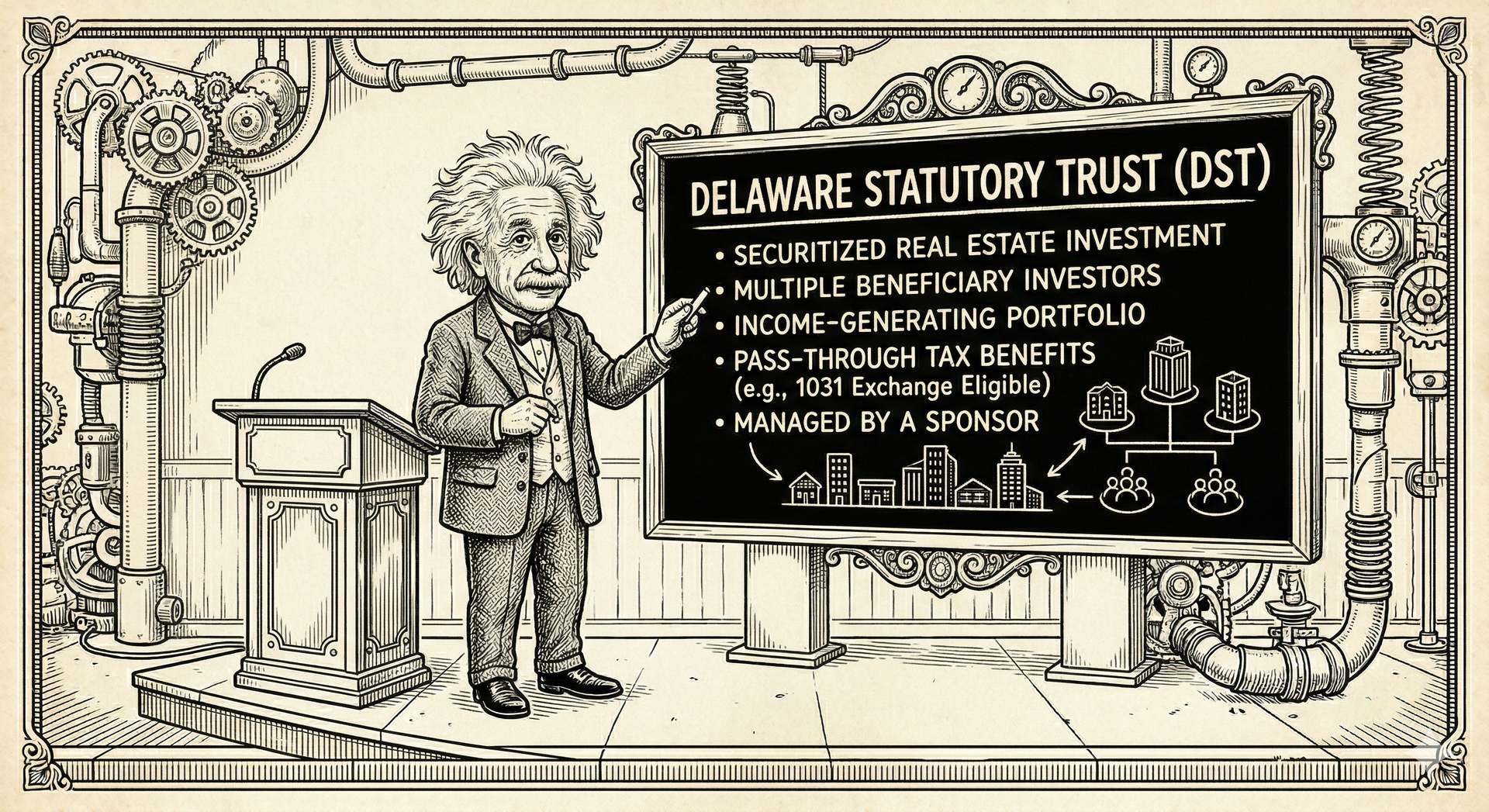
The Delaware Statutory Trust, or DST, has quietly become a more sophisticated alternative to the NNN acquisition for 1031 exchange investors. Not because it's flashier or newer, but because it handles risk in a structurally different way — a way that is worth understanding carefully before the 180-day clock runs out.
What You Are Actually Buying
You are not just buying yield. You are buying a lender relationship.
This is the point most NNN buyers miss entirely.
When you purchase a freestanding NNN property — a pharmacy, a fast-food pad, a dollar store — you are not just acquiring a building and a rent check. You are acquiring a loan. In almost every NNN acquisition at scale, there is mortgage debt attached: typically 50–65% loan-to-value, placed by a commercial lender whose underwriting was done against the current tenant's creditworthiness and the current lease terms.
The first-level thinker sees this and says: "Great, the tenant has a corporate guarantee and investment-grade credit." The second-level thinker asks: "What happens at lease expiration? What happens if the tenant's credit deteriorates? And what happens to my loan when either of those things occurs?"
A DST, by contrast, pools investor capital across multiple properties and, importantly, uses institutional-quality financing arranged at the trust level by the sponsor. The individual investor does not take on the lender relationship directly. The financing is already in place. The diversification across properties — sometimes a dozen or more — means that no single lease expiration, no single tenant bankruptcy, no single dark store situation can undo the entire investment.
The NNN is a single point of failure dressed in corporate clothing.
There is a particular type of cognitive error that arises when investors confuse a recognizable brand with a durable credit. Corporate tenants with nationally recognized names have declared bankruptcy at a rate that should, by now, make every commercial real estate investor pause. Bed Bath & Beyond. Tuesday Morning. Rite Aid. Pier 1. Casual Dining operators from coast to coast.
In each of these cases, investors in NNN-leased single-tenant properties faced the same brutal arithmetic: the tenant vacated, the rent stopped, and the loan remained. The building — often a highly specialized structure, purpose-built for one type of tenant — sat dark while the mortgage still required monthly service.
A DST portfolio spread across industrial, multifamily, self-storage, and retail assets does not eliminate this risk. But it distributes it across a wide enough base that the failure of any one operator does not constitute a portfolio-level event. That is a materially different risk profile than a single tenant on a single lease.
Time is not your friend in a 1031 exchange — and NNN sellers know it.
The 1031 exchange creates a time constraint that is, in behavioral terms, almost perfectly designed to produce poor decisions. You have 45 days to identify replacement property and 180 days to close. Sellers of NNN assets are fully aware of this dynamic. They know that 1031 exchange buyers are motivated, constrained, and often anchored to the notion that any closing is better than a failed exchange.
The DST solves this problem structurally. Because DST offerings are pre-assembled and pre-financed, an investor can often identify and close on a DST interest in a fraction of the time required to source, negotiate, and finance a standalone NNN acquisition. The velocity advantage of the DST is not just operationally convenient — it reduces the pressure that produces suboptimal choices.
The passive management assumption is imperfect on the NNN side.
The triple-net lease is marketed as passive. In practice, it is low-maintenance, which is not the same thing. Owners of NNN properties still manage the lender relationship. They field calls from the property manager when something is technically "structural" and falls outside the tenant's responsibility. They navigate lease renewal negotiations as expiration approaches — often years in advance. They handle lender approvals for lease modifications. They manage disposition when it's time to sell.
None of this is demanding. But it is not zero. And for a 70-year-old investor who just sold a 40-unit apartment building and wants genuine passivity, the distinction matters. A DST investor, by contrast, holds a beneficial interest in a trust. The sponsor manages everything. The investor receives K-1s and distributions. There is no landlord relationship whatsoever.
The Risk Assessment: What Could Go Wrong
No instrument is without its failure modes. The DST has meaningful risks that deserve direct acknowledgment.
Illiquidity
DST interests are not freely tradeable. There is a nascent secondary market, but it is thin and the pricing can be unfavorable to sellers. An investor who needs liquidity quickly — due to health expenses, family circumstances, or changed financial plans — may find the exit difficult. An NNN property, whatever its other flaws, can at least be listed for sale.
Sponsor Concentration Risk
In a DST, you are not just trusting a property — you are trusting a sponsor. If the sponsoring firm has weak underwriting standards, excessive fee structures, or operational deficiencies, those problems will flow through to the investor. The NNN buyer, for all their challenges, at least owns their asset directly.
7 Deadly Sins of DST Structure
The IRS ruling that allows DSTs to qualify as replacement property in a 1031 exchange (Revenue Ruling 2004-86) comes with strict prohibitions: no new financing after the offering closes, no new leases or lease modifications without IRS approval, no capital expenditures beyond normal maintenance. These restrictions can become binding in ways that harm the investment — particularly in a deteriorating property or a weak tenant situation where the sponsor's hands are tied.
Fees
DST programs carry upfront loads and ongoing fees that are visible if you read the Private Placement Memorandum carefully and invisible if you don't. A direct NNN acquisition has its own transaction costs, but the investor at least controls the negotiation.
Asymmetry of Risk on the Downside
In a DST with leverage, a significant property value decline can wipe out equity at the trust level. Unlike a direct owner who can negotiate with a lender individually, DST investors have no such flexibility — the sponsor negotiates on behalf of all investors, which may not align with any individual investor's interests.
What the Market Is Currently Doing
The 1031 exchange market has, over the past several years, tilted heavily toward NNN acquisitions for one primary reason: cap rates were compressed enough that DST cash-on-cash yields looked comparable to NNN yields, but NNN buyers felt they were getting something "real" — a deed in their name.
But cap rate compression in the NNN sector has been severe. Single-tenant retail cap rates in primary markets, at their trough, pushed below 4.5% for investment-grade tenants. At those prices, the yield advantage of owning a recognizable-brand building is almost entirely hypothetical — the math does not work unless you assume terminal value appreciation that is entirely dependent on cap rates remaining low.
The second-level thinker recognizes that this is where the pendulum sits: the consensus has priced NNN simplicity as though it carries no risk premium whatsoever. That is almost certainly wrong.
Meanwhile, DST offerings in industrial, multifamily, and necessity-retail sectors have continued to offer cash-on-cash yields in the 5–7% range with institutional sponsorship and built-in diversification. The spread between perceived safety and actual structural soundness has rarely been wider.
The Philosophy the Investor Should Adopt
Markets, like pendulums, do not stop at equilibrium. They overshoot in both directions. The NNN market has benefited from a decade of low rates, investor appetite for yield, and the powerful marketing of simplicity. Those conditions are not permanent.
The thoughtful 1031 exchange investor should approach this decision the way a careful architect approaches a foundation: not by asking "what is the most popular choice?" but by asking "what happens to this structure under stress?"
The NNN building answers that question narrowly. Its resilience is a function of one tenant, one lease, one lender, and one location. The DST answers the question more broadly. Its resilience is a function of many assets, many tenants, institutional sponsorship, and pre-arranged financing.
Neither is perfect. Both require careful due diligence. But the investor who mistakes simplicity for safety — who chooses the NNN because the choice feels clean — is making the same error that investors always make at this point in the cycle: confusing familiarity with durability.
The credo is not "always buy DSTs." The credo is this: understand what you are actually buying, not just what it looks like on the surface. A single-tenant building in a secondary market, leased to a category of retailer under secular pressure, financed at 60% LTV, approaching lease expiration — that is not a passive income stream. That is a compounding set of contingencies waiting to be resolved.
The 180-day clock creates urgency. Urgency is the enemy of clarity. The investor who uses that urgency as a reason to make a simpler choice, rather than a better one, will likely have more time than they want to reflect on the decision.
Choose structure over familiarity. That is not a revolutionary idea. It is simply good judgment applied consistently.
Recent Posts