1031 DST Properties: The Full Truth
The Market at Exit
DSTs are typically sold, or "liquidated," when the sponsor chooses to sell the underlying property. That decision is nominally made in the interest of the beneficiaries, but the timing is inevitably influenced by the sponsor's own fee economics and fund structure. The investor who entered at year zero may exit at year seven regardless of where the market is at that moment. The loss of control over exit timing is not hypothetical — it is the design.
The Setting: When the Tax Code Becomes the Product
There is a category of financial instrument that rarely appears in the headlines, generates no breathless coverage, and is never championed by a charismatic founder on a conference stage. Yet for a certain class of investor — typically someone sitting on a large, low-basis real estate position — it may be one of the more consequential decisions they ever make. These instruments are born not from innovation but from the careful reading of statutes. The Delaware Statutory Trust, or DST, is one of them.
To understand it properly, we must first understand the peculiar gravity of the tax code it orbits. Section 1031 of the Internal Revenue Code allows an investor who sells investment property to defer capital gains taxes by reinvesting the proceeds into a "like-kind" replacement property within a strict timeline: 45 days to identify a replacement, 180 days to close. This provision, though decades old, creates a recurring behavioral pattern: investors, unwilling to hand a substantial portion of their gains to the Treasury, scramble to find replacement properties. In a hot market, that scramble can force poor decisions. The clock, more than the fundamentals, drives the trade.
The DST exists, in large part, as an answer to that scramble. It is a pre-packaged, institutionally managed real estate vehicle that the IRS, in a 2004 Revenue Ruling, blessed as a valid 1031 exchange replacement. The investor does not need to find a property, negotiate a deal, or manage a tenant. They simply purchase a fractional beneficial interest in a trust that already owns the asset.
That convenience, of course, is both its appeal and its most significant risk.
The Core Logic: What the Structure Actually Does
The Legal Architecture
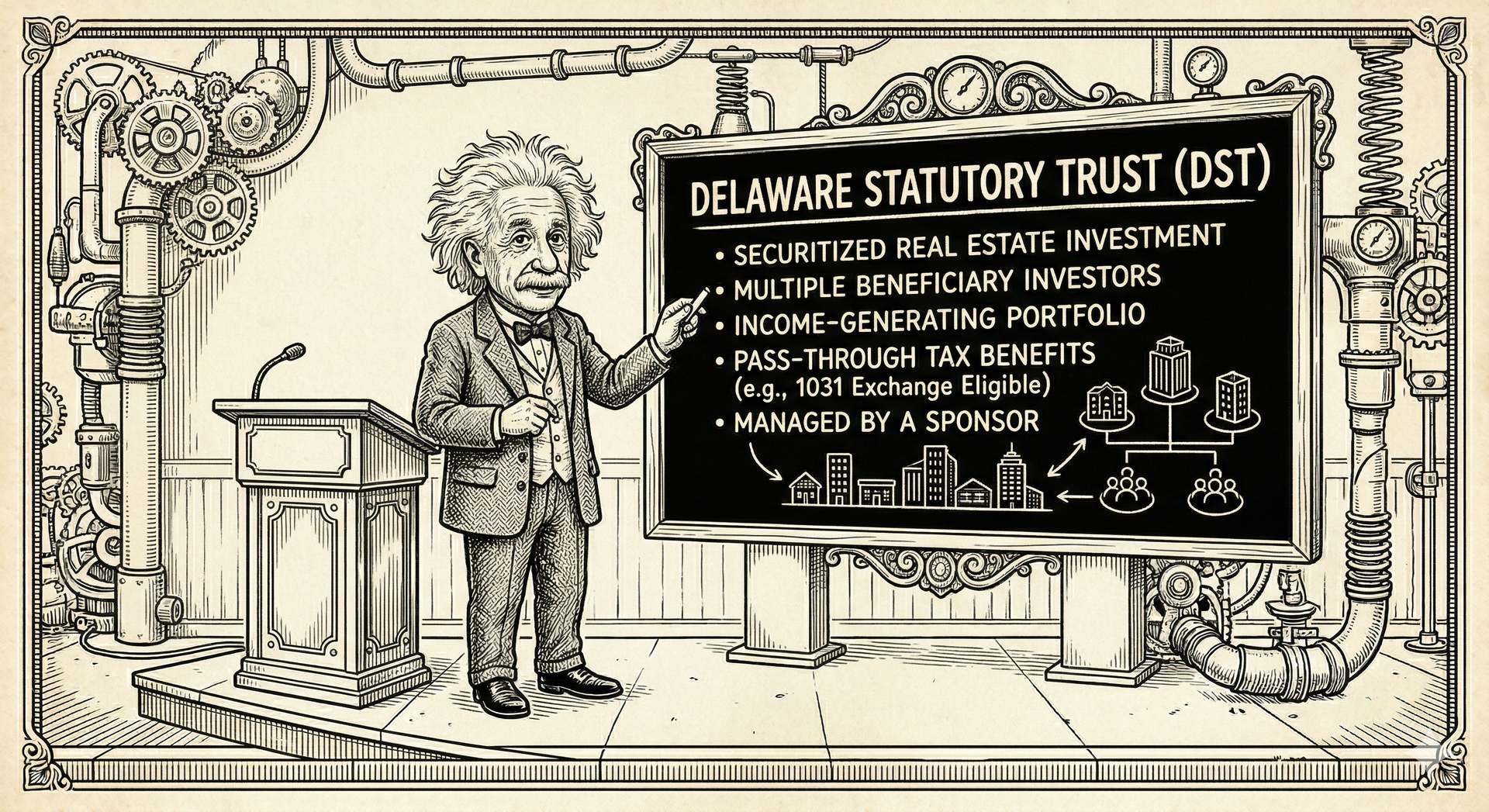
A DST is a trust formed under Delaware law — a jurisdiction with a long history of enabling flexible business structures. The trust holds title to one or more pieces of real property. Investors purchase "beneficial interests" in the trust, making them, in the eyes of both the law and the IRS, the economic owners of their proportional share of the underlying asset. Critically, the trust — not the individual investor — is the legal owner. This distinction is everything.
Sponsors (typically private real estate companies) acquire a property, place it inside a DST structure, and then sell fractional interests to individual investors, usually in minimum increments of $25,000 to $100,000. The property is managed by a master tenant — often an affiliate of the sponsor — who leases the entire property from the trust and is responsible for operations, maintenance, and tenant relations. The DST investors receive their proportional share of the net income, typically distributed monthly.
The 1031 Exchange Connection
Because the IRS has ruled that a DST interest constitutes real property for 1031 purposes, an investor who sells a building can exchange into a DST interest and legally defer their capital gains tax. This is enormously valuable in a world where a well-held piece of commercial property might carry a cost basis from decades ago. The deferred tax liability effectively functions as an interest-free loan from the government — capital that continues to compound inside the new structure rather than being reduced by a tax payment.
This is not a loophole. It is the explicit design of the code. The first-level observation is simply that DSTs allow tax deferral. The second-level observation is more interesting: the DST market exists because the alternative — paying capital gains taxes — is so painful that investors will accept substantial illiquidity and reduced control to avoid it. Understanding what behavior a structure is designed to channel tells you something important about the risks that structure will attract.
The Seven Deadly Sins of DST Operation
The IRS, in granting DSTs their 1031 blessing, imposed seven restrictions on what a trust may do. These are not minor footnotes — they are structural constraints that define the instrument's character:
- The trust cannot accept new capital contributions after formation.
- The trust cannot renegotiate the terms of existing loans.
- The trust cannot reinvest proceeds from a sale (other than in a limited reserve).
- The trust cannot enter into new leases or renegotiate existing ones (with narrow exceptions).
- The trust cannot make capital improvements beyond ordinary maintenance.
- The trustee cannot accept other assets.
- The trustee cannot contract on behalf of the trust beyond ordinary maintenance.
Read those restrictions carefully. A DST, once formed, is largely static. It cannot respond dynamically to market conditions. If the anchor tenant leaves, the trust cannot, without restructuring, pursue an aggressive re-leasing campaign. If interest rates shift and the debt terms become unfavorable, the trust cannot refinance on better terms. If the building requires a significant capital upgrade to remain competitive, the trust has limited ability to fund it.
This is the iron law of the structure: you trade control for convenience and tax eligibility.
The Investor Profile
The typical DST investor is not a Wall Street institutional allocator. They are often a business owner or real estate investor who has spent decades accumulating a property — a warehouse, an apartment complex, a shopping center — and now faces a decision: sell and pay taxes, or exchange and defer. They are older, often retired or near retirement, and the monthly income stream is meaningful to their financial plan. They value simplicity and passive income. They are not optimizing for upside. They are optimizing against a tax event.
This profile matters because it shapes the risk they tend to underestimate: the risk of illiquidity at precisely the moment life changes. DST investments typically have holding periods of five to ten years, with no secondary market of any meaningful depth. If the investor's circumstances change — health, family, liquidity needs — the investment offers very little flexibility.
The Risk Assessment: What the Pendulum Can Do to You
In physics, the pendulum's behavior is entirely predictable once you know the starting angle and the length of the arm. In markets, we know neither with certainty. The DST investor faces several distinct pendulum swings worth naming clearly.
The Sponsor Risk
The quality of the asset is inseparable from the quality of the sponsor. DST sponsors are private companies of widely varying capability, integrity, and incentive alignment. The investor who is exchanging out of a property they managed personally — where they knew every tenant, every lease, every capital need — is now delegating all of those decisions to an organization they likely evaluated over the course of a few documents and a phone call. The sponsor's fee structure (acquisition fees, asset management fees, disposition fees) can materially erode returns even in a performing deal.
The first-level thinker evaluates a DST by looking at the projected cash-on-cash yield. The second-level thinker asks: what happens to that yield if occupancy drops 10%? Who bears the cost of capital improvements if the seven restrictions don't allow the trust to fund them? What is the sponsor's track record across a full market cycle, not just the accommodative one?
The Illiquidity Premium That May Not Materialize
Investors in DSTs are compensated — in theory — for their illiquidity through yields that exceed what they might earn in more liquid vehicles. But in periods of cap rate compression (falling cap rates mean rising property prices), the absolute yield on a DST interest may look thin relative to the illiquidity being accepted. The investor has accepted a fixed position in a specific asset at a specific moment in the cycle. If that moment turns out to be near the top, the illiquidity premium does not help them.
The history of real estate cycles offers a consistent lesson: the assets acquired in the late stages of a bull market, often by investors chasing exchange deadlines, tend to underperform those acquired with patience and selectivity. The 45-day identification window is the enemy of cycle awareness.
The Leverage Embedded in the Asset
Most DST properties carry institutional debt — often non-recourse to the individual investor, which is presented as a feature. And it is, up to a point. But leverage amplifies the swing of the pendulum in both directions. A DST holding a retail property with 60% loan-to-value, financed at a fixed rate that matures in seven years, faces refinancing risk that the investor may not have contemplated at the time of purchase. If rates are materially higher at maturity, the math of the deal changes significantly.
The investor who was told they owned "a passive interest in a Class A office building" may, five years later, find themselves navigating a discussion about a special assessment or a loan modification — precisely the kind of active management they thought they had left behind.
The Market at Exit
DSTs are typically sold, or "liquidated," when the sponsor chooses to sell the underlying property. That decision is nominally made in the interest of the beneficiaries, but the timing is inevitably influenced by the sponsor's own fee economics and fund structure. The investor who entered at year zero may exit at year seven regardless of where the market is at that moment. The loss of control over exit timing is not hypothetical — it is the design.
The 1031 Daisy Chain
Many DST investors intend to execute another 1031 exchange at the exit — rolling their proceeds into yet another replacement property and continuing to defer taxes. This strategy depends on: (a) the investor still being alive and capable of making investment decisions, (b) the existence of suitable replacement properties at the time of sale, and (c) the continued existence of the 1031 exchange provision itself. Tax law is not permanent. An investor building a multi-decade financial plan around the perpetual availability of a specific tax provision is making a significant implicit assumption.
The Asymmetry of Outcomes
Here is the asymmetry worth understanding clearly: the upside of a DST investment is largely bounded. The structure cannot adapt, cannot reinvest cash flows aggressively, cannot pursue opportunistic capital improvements. The investor participates in the income stream and the eventual appreciation — but the seven restrictions ensure they cannot amplify that return through active management. The downside, however, can be less bounded. A significant vacancy event, a market dislocation at the exit, or a poorly underwritten debt structure can produce outcomes materially worse than the projected case.
This is the opposite of the asymmetry a sophisticated investor seeks. In general, one wants to own instruments where the downside is bounded and the upside has room to run. In a DST, you have accepted a bounded upside (no active management, fixed structure) in exchange for tax deferral and a passive income stream. The question is not whether this is a bad instrument. It is whether the investor understands precisely what they have exchanged, and whether the specific asset, sponsor, and market moment justify the trade.
Conclusion: A Credo for the Deliberate Investor
A Delaware Statutory Trust is not a shortcut. It is a specific tool, engineered for a specific problem — the tax-efficient transition out of directly held real estate — and it carries a specific set of trade-offs that must be understood with clear eyes before capital is committed.
The philosophy I would commend to any investor considering a DST is this:
- Begin with the tax question, but do not end there. The 1031 exchange benefit is real and meaningful. But it is a starting point for analysis, not a conclusion. The fact that you can defer taxes by exchanging into a DST tells you nothing about whether a particular DST, at a particular price, in a particular market cycle, represents sound allocation of capital.
- Treat the sponsor as the primary risk factor. The asset is important. The market is important. But over a five-to-ten-year hold, the sponsor's judgment, integrity, and capability will likely determine more of your outcome than any other single variable. Underwrite the operator as rigorously as you underwrite the asset.
- Recognize the illiquidity for what it is. This is not the kind of illiquidity that earns a premium in efficient markets because sophisticated investors are being compensated for locking up capital. This is the kind of illiquidity that often goes unrecognized until circumstances change and the investor needs something the structure cannot provide.
- Think about the exit before you enter. The most common error in DST investing is to evaluate the investment based on current yield and projected income without equally rigorous thought about the conditions under which the asset will be sold, and who will be making that decision.
- Do not confuse simplicity with safety. The DST is, by design, a simple vehicle to own. Monthly income arrives. No tenant calls. No maintenance decisions. This simplicity is attractive — and it is partially an illusion. The complexity does not disappear; it is delegated. The investor who owned a building and managed it directly understood every risk in real time. The DST investor owns those same risks, but now receives the information about them filtered through a sponsor's quarterly report.
In the end, the DST is a reasonable answer to a real problem. But like all reasonable answers in finance, it is available in both responsible and irresponsible versions, and the difference is rarely visible from the outside at the moment of purchase. The pendulum of the real estate cycle does not stop swinging because a trust document has been executed. The patient, skeptical, second-level thinker will use the DST as one tool among many — neither dismissing it nor being seduced by its tax-deferral elegance into overlooking the risks that the structure, by its very design, cannot eliminate.
The goal, as always, is not to find the perfect instrument. It is to understand the instrument you hold.
Recent Posts