The Quiet Compounder: A Rational Case for the Delaware Statutory Trust
The Pendulum Always Overshoots
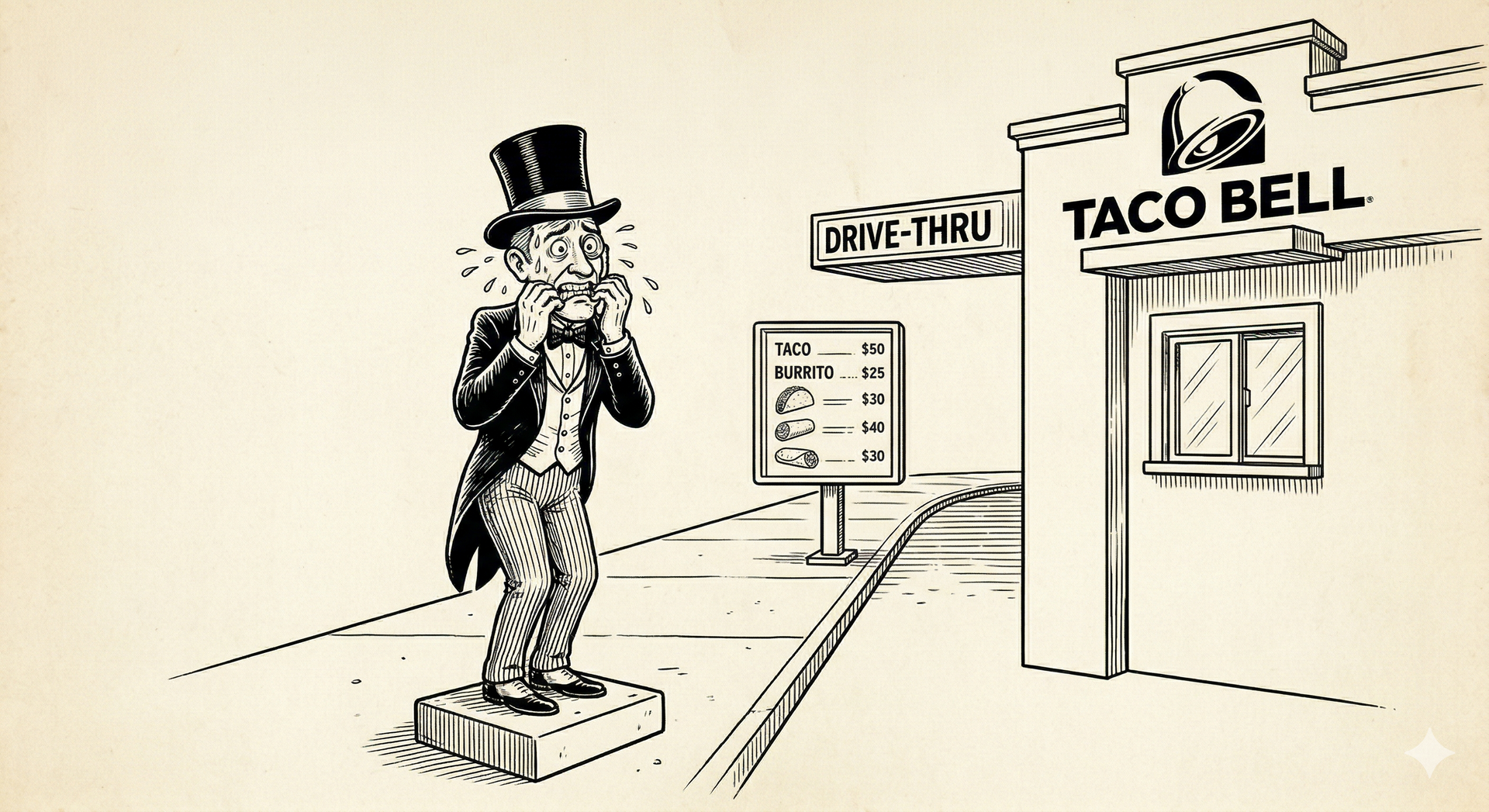
There is an old observation in markets: the pendulum of investor preference never stops at the midpoint. It swings from fear to greed, from complexity to simplicity, from tangible assets to financial abstractions and back again. Right now, the pendulum sits somewhere in the middle of a long arc — capital is expensive, public equity multiples remain elevated relative to their historical averages, and the era of near-zero interest rates has, perhaps permanently, repriced the cost of impatience.
In this environment, a curious instrument has attracted renewed attention from a very specific class of investor: those holding low-basis real estate who are staring at a capital gains bill that would, in plainer language, confiscate a meaningful portion of a lifetime of work. The instrument is the Delaware Statutory Trust, or DST.
It is not new. It was not invented in a bull market to package risk cleverly. Its legal structure predates the modern hedge fund era, and its primary utility — qualifying as a replacement property under Section 1031 of the Internal Revenue Code — has existed in some form since 1921. That longevity matters. In a world full of structures designed primarily to generate fees, the DST's persistence across a century of tax law is a meaningful signal.
But persistence alone is not a sufficient investment thesis. So let us think carefully about what a DST actually offers, and — critically — where it does not.
Five Reasons the Structure Earns a Seat at the Table
"The first-level thinker says: 'It's just a tax deferral.' The second-level thinker asks: 'What is the compounded value of that deferral over 15 years, and how does that compare to the after-tax return of selling outright?'"
-Jerry Baker, Founder Baker 1031 Investments
- Tax deferral is not a loophole — it is a return multiplier. When an investor exchanges appreciated property into a DST under a 1031 exchange, the capital gains tax event is deferred, not eliminated (unless the investor holds through death, at which point the step-up in basis eliminates the embedded gain entirely). The compounding math here is non-trivial. A $500,000 deferred tax bill, reinvested at even modest real estate yields for 15 years, becomes substantially more than $500,000. The government, in effect, is providing an interest-free loan equal to your tax liability. Few legal mechanisms in the tax code offer this kind of structural advantage at this scale.
- Passive income without operational drag. The DST investor holds a beneficial interest in an institutional-grade asset — often a class-A apartment complex, medical office building, net-lease retail, or industrial facility — without any management responsibility. For the aging landlord who has spent three decades fielding 2 a.m. calls about broken water heaters, this is not a trivial benefit. Time, once spent, cannot be recovered. The transition from active operator to passive beneficiary is worth something that does not appear in any prospectus.
- Access to institutional real estate at retail scale. A DST allows a $500,000 investor to own a fractional interest in a $60 million distribution center or a 400-unit apartment community — assets that would otherwise require either enormous capital or partnership structures far more complex and less transparent. This is genuine democratization of the institutional asset class, not the marketing department variety.
- Portfolio diversification across asset types and geographies. Rather than rolling exchange proceeds into a single replacement property — which concentrates risk — an investor can divide capital across multiple DST offerings. A 1031 exchange allows multiple replacement properties. This means one can simultaneously hold interests in multifamily in the Sun Belt, industrial in the Midwest, and medical office in the Northeast. Geographic and sector diversification, historically available only to institutional allocators, becomes structurally accessible.
- Estate planning utility that is frequently underappreciated. Because a DST interest is a beneficial ownership stake — not direct property ownership — it passes through an estate with far greater ease than a deed to real property. There are no probate delays on the real estate itself, fewer jurisdictional complications, and the step-up in basis at death can, under current law, eliminate the deferred gain entirely. For investors approaching the latter stages of their wealth-building journey, this is not an afterthought. It may be the single most compelling feature of the structure.
What the Pendulum Doesn't Show You on the Upswing
Howard Marks, founder of Oaktree, once wrote that the most dangerous words in investing are "the risk is low." Not because risk is always high, but because confidence in low risk is the precondition for the accumulation of hidden risk. DSTs are no exception. The following risks deserve explicit acknowledgment before any allocation decision:
Illiquidity — the price of admission
DST investments are not publicly traded. There is no secondary market of meaningful depth. An investor who needs capital during the hold period — typically 5 to 10 years — will find the exit narrow and the price discovery poor. This is not a bug unique to DSTs; it is a feature of all private real estate. But it must be sized accordingly. Capital allocated here should genuinely be capital that can afford to be patient.
Sponsor quality is the variable that matters most
The DST structure is only as sound as the sponsor who selects, underwrites, and manages the underlying asset. There are sponsors with decades of institutional-quality track records, and there are sponsors whose primary expertise is in raising capital. The difference between them will not be visible in a summary brochure. Diligence on sponsor history, alignment of interest, fee structures, and asset selection criteria is not optional — it is the work.
The structure restricts operational flexibility
Once a property is placed into a DST, the IRS places strict limitations on what the trustee can do. No new financing, no capital expenditure beyond routine maintenance, no renegotiation of leases on materially different terms. If market conditions require a strategic pivot — refinancing in a lower-rate environment, capital improvement to maintain competitiveness — the DST structure cannot accommodate it. The asset must essentially operate as-is for the duration of the trust.
The deferral is only as valuable as the tax law that enables it
Section 1031 has survived every major tax reform in the last century. But it has been narrowed (in 2017, it was restricted to real property only, eliminating personal property exchanges). Future legislative risk is real, though historically, changes have been prospective rather than retroactive. Investors should not underwrite a DST strategy on the assumption that the step-up in basis will remain intact at death — that provision, in particular, has drawn legislative attention in recent budget debates.
Real estate is not immune to cycles
The 2022–2024 rate environment reminded institutional real estate investors of something they had largely forgotten during the era of cheap money: leverage is a double-edged instrument. A DST financed at 55% LTV with a loan originated at 2024 interest rates carries interest cost that requires solid occupancy to service. If the underlying asset faces vacancy pressure or rent concessions, the distribution to beneficial interest holders will feel that pressure first.
A Credo for the Patient Capital Allocator
Bill Gross, founder of PIMCO, used to say that the best investment strategies are not about predicting the future — they are about identifying the structures that reward patience and punish impatience. The DST, at its best, is exactly such a structure. It rewards the investor who can think in decades, who understands that deferring a tax today and letting the compound function run is not cleverness — it is mathematics.
But the structure alone is not the strategy. A mediocre asset inside a tax-efficient wrapper remains a mediocre asset. The wrapper does not transform the economics of the underlying property; it only determines how much of those economics the government captures at each step.
The investor who approaches DSTs correctly holds the following beliefs simultaneously:
The DST investor's credo
- Tax efficiency is a legitimate edge — not a shortcut — and the 1031 exchange is one of the few remaining structural advantages available to the individual real estate investor.
- Illiquidity is a risk I can be paid for if I size it correctly. Capital I cannot afford to lock up for seven years should never enter this structure.
- Sponsor selection is the primary investment decision. The asset class is the context; the operator is the bet.
- I will not confuse tax deferral with asset quality. A bad building in a good wrapper is still a bad building.
- The step-up in basis at death is a planning tool, not a guaranteed outcome. I will underwrite with the deferral; I will hope — but not depend on — the elimination.
- I am not smarter than the market, but I can be more patient than the average participant. Patience, in this structure, compounds.
The DST is a product that sells a structure that rewards a specific kind of investor: one who has built something real, is thinking seriously about transition, and understands that the government has inadvertently created a tool for compounding that most investors walk right past.
The pendulum, as always, will swing. Capital gains tax rates will change. Interest rates will move. Real estate fundamentals will cycle. But the core logic of deferring a tax liability and letting it compound on your behalf — rather than the government's — is as durable as the mathematics behind it.
That is not a trend. That is a law of nature.
Recent Posts