Deferred, Then Gone: 721 DST Exchanges, Estate Planning, and Retirement
History Doesn't Repeat, But It Does Rhyme with Capital Gains
In 1921, Congress enacted the precursor to what would become Section 1031 of the Internal Revenue Code — a recognition that taxing the exchange of like-kind assets was, in effect, taxing the act of thinking rather than the act of earning. A farmer who traded one field for a more productive one hadn't realized wealth; he had merely repositioned it. The tax would come when he finally harvested the gains in cash.
That foundational logic — defer the tax until genuine realization — has held for over a century. And yet most real estate investors who have spent decades building equity in appreciated property still approach exit as if their only options are a taxable sale or a 1031 exchange into another operational headache. The 721 exchange, paired with a Delaware Statutory Trust as an intermediary vehicle, offers a third path. It is not new. But it remains, stubbornly, underutilized.
The first-level thinker hears "real estate fund" and thinks illiquidity, fees, and complexity. The second-level thinker asks: compared to what? Compared to managing a single tenant, a single roof, and a single zip code's economic fortune — an institutional REIT operating partnership, accessed through a structured exchange, may look like the more elegant position.
What the 721 Exchange Actually Does — and Why the DST is the Bridge
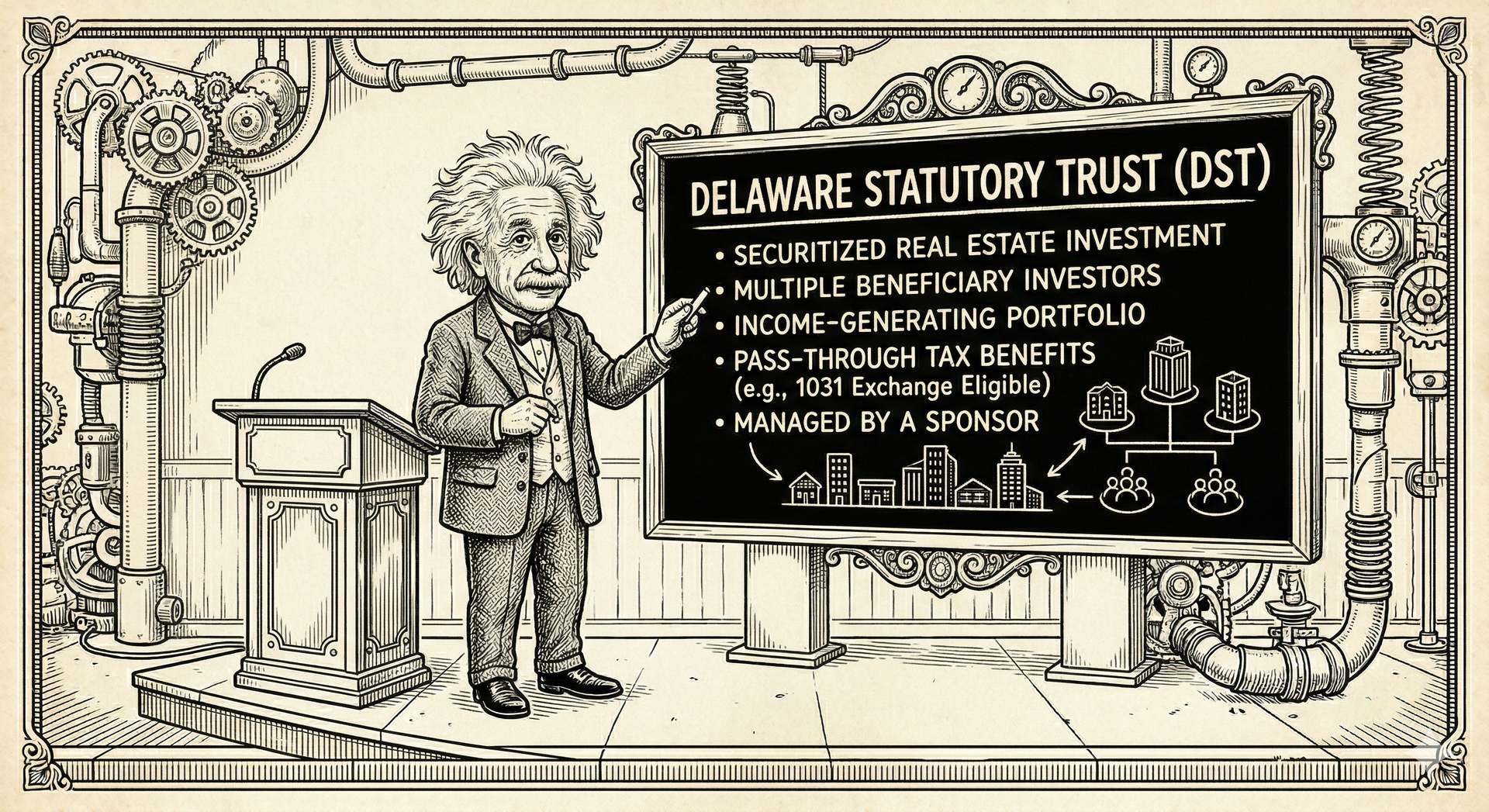
A 721 exchange, formally known as an "UPREIT contribution," allows a property owner to contribute appreciated real estate directly into a Real Estate Investment Trust's operating partnership in exchange for Operating Partnership Units (OP Units) — without triggering immediate capital gains tax. The logic mirrors 1031: no cash changes hands, so no tax event is deemed to occur.
The wrinkle is that most large REIT operating partnerships won't accept a single investor's strip mall or apartment building directly. They operate at an institutional scale. This is where the Delaware Statutory Trust enters as the structural bridge.
Step 1 - 1031 into a DST
Investor sells appreciated property and executes a standard 1031 exchange into a DST — a qualified replacement property that preserves deferral and removes management burden immediately.
Step 2 - DST Season & Seasoning
The investor holds the DST interest — typically 2–5 years. This seasoning period satisfies IRC requirements and establishes the property's character as a held investment, not inventory.
Step 3 - 721 Contribution
The DST sponsor contributes the underlying properties into an affiliated REIT operating partnership. DST interests convert to OP Units on a proportional basis — tax-free, per IRC §721.
Step 4 - OP Units & Beyond
The investor now holds OP Units in an institutional REIT. These may convert to publicly traded REIT shares (taxable event) or be held, receiving distributions and benefiting from diversification indefinitely.
The elegance is architectural. Each step has legitimate independent economic purpose. No step is manufactured solely for tax avoidance. The investor genuinely transitions from an active, concentrated, management-intensive asset to a passive, diversified, professionally managed portfolio — and the tax code recognizes that transition as a repositioning, not a liquidation.
"The tax tail should never wag the investment dog. But when the tax tail and the investment logic point in the same direction, the disciplined investor pays close attention."
-Jerry Baker, Founder of Baker 1031 Investments
Why This Structure Deserves Serious Consideration
- On deferral compounding. Capital gains taxes on a long-held appreciated property can approach 35–40% of gain when federal, state, and depreciation recapture are aggregated. That is not a rounding error. It is the difference between redeploying $1 and redeploying $0.60. Compounded over another decade, the retained capital earns returns on the full dollar. The math here is not subtle.
- On concentration risk. The investor who has spent 30 years building equity in a single market, single asset class, or single tenant relationship has taken on a form of risk that is almost never adequately priced into their return expectations. A single vacancy, a single zoning change, a single employer exodus can impair years of compounding. Diversification into an institutional portfolio is not a surrender of return potential — it is a repricing of risk that most concentrated holders have been carrying for free.
- On management burden. The economics of active real estate management are rarely honestly accounted for. Time has value. Liability has value. The phone call at 11pm has value. When an investor transitions from operator to passive unit holder, the implicit return on those recaptured hours is real — it simply doesn't appear on any spreadsheet.
Deferred, Then Gone: How the 721 DST Interacts with the Step-Up in Basis
Of all the structural advantages embedded in the 721 DST path, the most underappreciated is the one that benefits people who are no longer alive to use it. Under current law, assets held at death receive a "step-up" in cost basis to their fair market value at the date of death. This means a lifetime of deferred capital gains — accumulated through decades of 1031 exchanges, DST holdings, and UPREIT contributions — may effectively disappear for the investor's heirs.
Consider what this means in practice. An investor who purchased a commercial property in 1985 for $400,000, exchanged it forward through multiple 1031s, and ultimately holds OP Units in an institutional REIT worth $4 million at death has a $3.6 million embedded gain. If they had sold at any point along the way, that gain would have been taxable. Because they held through death, their heirs inherit the OP Units at a $4 million basis — and the gain is gone entirely.
This is not a loophole. It is the designed interaction of two long-standing provisions of the tax code — deferral under §721 and the stepped-up basis rules under §1014. The structure does not create the step-up; it simply preserves the deferral long enough for the step-up to matter.
How estate planners use this structure: Estate attorneys and financial planners who work with high-net-worth real estate investors increasingly view the 721 DST path not as a tax strategy but as a wealth transfer strategy. The logic is layered. First, the investor exits active management without triggering gain — preserving more capital to compound. Second, the OP Units are easier to transfer, gift, or hold in trust than a direct real estate interest. Third, the REIT's professional management ensures the asset doesn't deteriorate through a period of estate administration. Fourth, the step-up resets the clock entirely for the next generation.
- DST & OP Units in trust structures: Both DST beneficial interests and REIT OP Units can be held within revocable living trusts, irrevocable trusts, and certain charitable vehicles. This makes them far more administratively tractable than fractional interests in direct real estate at death.
- Charitable remainder trusts (CRTs): Some investors contribute DST interests or OP Units into a Charitable Remainder Trust. The CRT sells the asset tax-free, reinvests the proceeds, pays the investor income for life, and passes the remainder to charity — combining income, deferral, and legacy in a single structure.
- Annual exclusion & lifetime gifts: OP Units can be gifted to family members using annual exclusion gifts ($18,000 per recipient in 2024) or applied against the lifetime exemption. Gifting appreciating OP Units removes future appreciation from the taxable estate while keeping the asset productive.
- Portability & QTIP structures: OP Units held in a QTIP trust can provide income to a surviving spouse while preserving estate tax benefits. The unlimited marital deduction defers estate tax further, compounding the benefit of the step-up that ultimately arrives at the second death.
The professional ecosystem around 721 DST estate planning is narrow but well-defined. It typically involves a collaboration between a DST sponsor or broker-dealer registered with FINRA, an estate planning attorney with real estate tax experience, a CPA who can model the basis and gain scenarios, and a financial advisor who holds a Series 7 or Series 65 license (DST interests are securities). The investor who assembles this team before a sale — not after — is the one best positioned to navigate the structure's requirements.
"The step-up in basis is not guaranteed forever. It has been proposed for elimination in nearly every major tax reform discussion of the past two decades. The investor who relies on it as a permanent feature of the code is making a political prediction, not an investment decision."
-Jerry Baker, Founder of Baker 1031 Investments
From Operator to Income Recipient: The 721 DST as a Retirement Income Engine
Most real estate investors approaching retirement face a version of the same problem: their wealth is productive but their lifestyle is not. The property generates income, but it also generates calls about broken HVAC systems, lease disputes, and property tax appeals. The investor is asset-rich but time-poor — and as they age, the management burden grows heavier relative to the returns.
The 721 DST path addresses this directly. The transition from active operator to passive OP Unit holder is, in the most literal sense, a transition from a job to an investment. The REIT's distributions — typically paid quarterly — replace the net operating income the investor previously managed to collect, without any of the operational friction. For a retiree who has spent 30 years as a landlord, this is not a small quality-of-life improvement.
How the income mechanics work. REIT operating partnerships are required by law to distribute at least 90% of their taxable income to unit holders annually. This structural obligation provides a degree of income predictability that is genuinely different from direct real estate, where vacancy, capital expenditures, and lease timing can create lumpy and unpredictable cash flows. For retirement income planning, predictability has a value that is separate from yield level.
- Distributions: OP Unit distributions from well-capitalized REITs have historically ranged from 4% to 6% annually. Compared to a Treasury bond, the yield is competitive. Compared to managing a tenant, the risk-adjusted value is often superior.
- Return of capital: REIT distributions carry a mixed tax character. A portion may be classified as return of capital (not immediately taxable, but reduces basis), qualified dividend income, or ordinary income. The blended effective rate is often lower than an investor expects.
- IRA & qualified plans: OP Units held outside of retirement accounts do not trigger Required Minimum Distributions. This gives retirees flexibility in managing their taxable income — drawing on REIT distributions as needed while allowing IRA accounts to grow or be drawn down strategically.
- REIT income & tax benefits: REIT distributions count as income for Social Security benefit taxation thresholds. Retirees who are sensitive to this threshold should model the combined impact of REIT distributions and Social Security income before committing to the structure.
Who is this structure actually built for? The 721 DST retirement path is not a universal solution. It is a precise instrument for a specific type of investor. The profile that most consistently benefits from the structure shares common characteristics.
- The retiring landlord: Ages 60–75. Owns 1–4 commercial or multifamily properties with substantial embedded gain. Wants out of active management but cannot afford the tax bill of a straight sale. Willing to hold for 5+ years.
- The estate-conscious owner: Investor whose primary goal is wealth transfer. Less focused on current income than on passing appreciated assets to heirs with minimal tax erosion. Often works closely with an estate attorney.
- The income-needs retiree: Investor whose direct real estate income has become irregular or management-intensive. Values the predictability of REIT distributions over the potential upside of continued direct ownership.
- The control-oriented operator: Investor who derives satisfaction or security from direct ownership and control. The 721 path requires surrendering all decision-making authority. For this investor, the psychological cost is real and often underestimated.
The retirement income sequence. A disciplined approach to the 721 DST as a retirement tool treats it as one layer in a broader income stack — not the entire foundation. Ideally, the retiree holds a combination of Social Security income (delayed to 70 for maximum benefit), a modest fixed income allocation, REIT distributions from OP Units, and sufficient liquid reserves to avoid forced liquidation of any position during a market disruption. The REIT distributions fill the middle layer — above the floor of guaranteed income, below the ceiling of growth assets.
"A retirement income plan built entirely on REIT distributions is like a sprinter who only trains one muscle group. The structure is good. The concentration is the problem."
-Jerry Baker, Founder of Baker 1031 Investments
What Could Go Wrong — and the Asymmetry Worth Understanding
- Legislative risk. Congress can and does change the tax code. Section 1031 was narrowed in 2017. Section 721 treatment for UPREIT contributions has been stable, but any administration that views REIT structures as tax shelters could propose modifications. The step-up in basis under §1014 has been specifically targeted in recent reform proposals. This is the single largest systemic risk to the entire structure.
- Structural execution risk. A 721 exchange is not a commodity product. The quality of the DST sponsor, the underwriting of the underlying properties, the specific REIT into which the contribution occurs, and the terms of the OP Unit agreement matter enormously. Poor execution at any stage can trap capital in illiquid, underperforming vehicles with limited recourse.
- The future 721 is never guaranteed. Many DST sponsors market their products with language implying that a 721 conversion into a REIT OP is the natural conclusion. It is not contractually required. If the sponsor's affiliated REIT does not execute the contribution, the investor may hold a DST interest indefinitely with limited exit options.
- Retirement income interruption risk. REIT distributions are not guaranteed. During periods of economic stress — 2008, 2020 — many REITs reduced or suspended distributions. A retiree who has structured their income plan around REIT distributions without adequate reserves may face a liquidity gap precisely when other assets are also under pressure.
- Longevity and inflation risk. A fixed or slowly growing distribution from a REIT may not keep pace with inflation over a 25–30 year retirement. The investor who enters the structure at 65 and lives to 92 may find that the real purchasing power of their distributions has eroded meaningfully. Unlike direct real estate, they have no ability to raise rents unilaterally.
- Estate planning assumption risk. The entire step-up benefit depends on the investor holding OP Units until death. Unexpected liquidity needs, medical costs, or family circumstances may force a conversion of OP Units to REIT shares — a taxable event — before death occurs. The plan that assumes a clean hold-through-death outcome must be stress-tested against real-world contingencies.
- Fee drag at multiple layers. DSTs carry management fees. REIT operating partnerships carry management fees. Broker-dealers who distribute DSTs earn commissions. The aggregate fee burden is meaningfully higher than direct ownership. The tax deferral benefit must be large enough to absorb this drag and still produce superior after-tax, after-fee outcomes. In many cases it is. In some, it is not.
"A retirement income plan built entirely on REIT distributions is like a sprinter who only trains one muscle group. The structure is good. The concentration is the problem."
-Jerry Baker, Founder of Baker 1031 Investments
What Should Guide Your Decision
Investment structures are neither good nor bad in the abstract. They are appropriate or inappropriate for specific investors in specific circumstances. The 721 DST path is most defensible for the investor who meets a narrow but not uncommon profile: substantial embedded gain in actively managed real estate, a genuine desire to shed operational responsibility, a long time horizon, estate planning objectives, and the patience to navigate a multi-year, multi-step process with imperfect information.
For that investor — particularly one entering retirement with heirs in mind — the 721 DST is not a tax trick. It is a rational repositioning of a concentrated, illiquid, management-intensive asset into a diversified, institutional, passive structure that generates regular income, preserves deferral, and may extinguish decades of embedded gain at the moment of death. The tax code, in this instance, is functioning as designed rather than being circumvented.
Recent Posts