
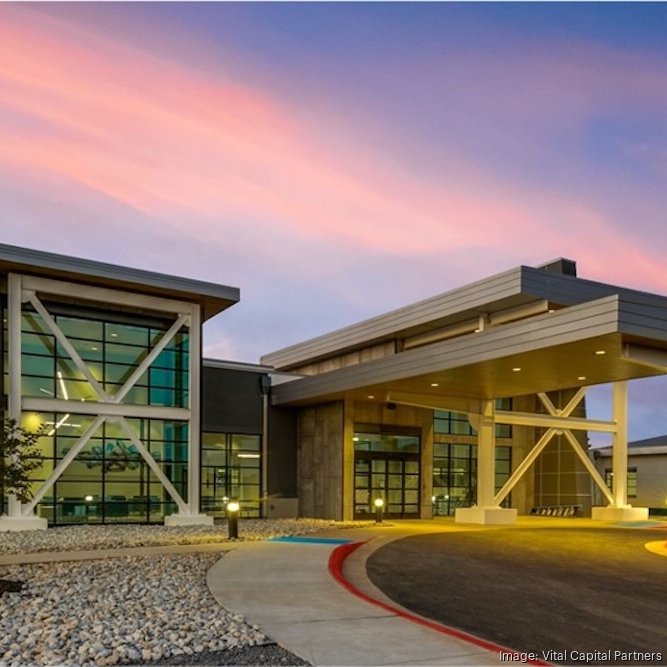
Vital Capital Medical - Temple is a single-tenant net-leased healthcare DST holding the Temple Rehabilitation Hospital, a 36-bed, ~38,817 SF inpatient rehabilitation facility built in 2018 in the Killeen-Temple MSA. It is master-leased to a sponsor affiliate that has assumed an absolute-net sublease to operator CRH of Temple (parent Lifepoint Health, B/B2), with ~7.5 years of term remaining plus three extension options, acquired in November 2025 for $29.695M and financed with an $18.59M First Horizon loan (5.65% effective fixed via swap, interest-only for four years then 25-year amortization, 53.81% LTC). The forecast targets a 7.32% Year-1 cash-on-cash building to 7.91% by Year 4 (averaging 7.28% over a seven-year hold), with a discretionary 721 UPREIT exit.
Vital Capital Medical - Temple TX DST is a single-tenant, net-leased healthcare Delaware Statutory Trust holding the Temple Rehabilitation Hospital, a 36-bed inpatient rehabilitation facility of approximately 38,817 SF on a ~6-acre site at 23621 SE H K Dodgen, Temple, Texas (Killeen-Temple MSA, on the I-35 corridor between Austin and Waco). Built in 2018, the purpose-built hospital treats stroke, brain-injury, neurological, orthopedic, and cardiac rehabilitation patients. 5 years of term remaining and three 5-year extension options.
81% loan-to-cost. 28% over a seven-year hold, with a discretionary 721 UPREIT exit.
| Lender | First Horizon Bank |
| Interest Rate | 5.65% (Fixed) |
| Loan Term | 7 years |
| Interest-Only Period | 4 years |
| Amortization | 25 years |
| Total Debt | $18.6M ($18,593,750) |
| In-Place LTV | 53.81% |
| Year 1 DSCR | 2.24x |
Income depends on a single healthcare operator, CRH of Temple, LLC, whose parent is Lifepoint Health, rated B by S&P and B2 by Moody's. This is a speculative, non-investment-grade credit, so the roughly 7.3% projected yield is in substantial part compensation for operator-credit and healthcare-reimbursement risk rather than a low-risk coupon, and a Lifepoint or operating-tenant distress event would directly impair the Trust's rent.
The asset is a 2018-built, purpose-built 36-bed inpatient rehabilitation hospital, a highly specialized single-use facility serving stroke, brain-injury, and neurological rehabilitation. Specialization supports the operator's clinical franchise and switching costs, but it sharply limits alternative use: if the operator vacates or fails, re-leasing to another licensed inpatient-rehab operator would be costly and slow, and residual value is tightly tied to continued healthcare use.
The Property is held on an absolute-net basis through a master-lease/sublease structure, with the Sponsor-affiliate Master Tenant interposed between the Trust and the third-party operating tenant; the operating tenant bears taxes, insurance, and maintenance and holds three 5-year renewal options. With only ~7.5 years of remaining term against a seven-year hold, the disposition coincides with meaningful term burn-off, so exit value depends on a renewal or a buyer underwriting re-leasing risk on a short-dated, single-tenant medical asset.
Located in the Temple Medical District along the I-35 corridor between Austin and Waco within the growing Killeen-Temple MSA, the hospital benefits from a deep regional healthcare employment base (Temple is a major medical hub) and demographic tailwinds supporting inpatient-rehab demand. The location supports the operator's patient catchment, though the investment's performance remains tied to that single operator rather than to broad market dynamics.
The acquisition was financed with an $18,593,750 First Horizon Bank loan swapped to a 5.65% effective fixed rate, interest-only for four years and then amortizing over 25 years through a November 2032 maturity, producing a strong early DSCR (2.24x) that steps down toward ~1.94x when principal payments begin in Year 5. The acquisition was partly funded by ~$11.5M of Sponsor and MBRE preferred bridge equity to be redeemed by offering proceeds, so the structure carries bridge-carry cost and reliance on full syndication, alongside customary affiliate conflicts.
The offering delivers an above-average projected income stream (7.32% Year-1 cash-on-cash building to 7.91% by Year 4, averaging 7.28% over the seven-year hold) from a modern, 2018-built, 100%-leased inpatient rehabilitation hospital on an absolute-net lease, with the operating tenant responsible for taxes, insurance, and maintenance and holding three 5-year renewal options. The asset sits in the Temple Medical District along the high-traffic I-35 corridor within the growing Killeen-Temple MSA, a genuine regional healthcare hub, and was acquired at essentially its appraised value with moderate leverage (53.81% loan-to-cost) on a 5.65% swapped fixed-rate loan that is interest-only for four years, supporting a strong early DSCR of 2.24x. A discretionary 721 UPREIT exit offers a potential pathway to REIT-unit liquidity and diversification.
The income rests on a single operator of a single special-purpose asset, and the operator's parent, Lifepoint Health, carries speculative-grade ratings (B/B2), so the elevated yield is materially a credit-risk premium and a Lifepoint or operating-tenant distress event would directly threaten the rent. The 36-bed inpatient rehabilitation hospital is a highly specialized facility with limited alternative use, creating substantial re-leasing cost and downtime risk, and with only ~7.5 years of remaining lease term against a seven-year hold the planned exit coincides with significant term burn-off, leaving terminal value dependent on a renewal or a buyer willing to underwrite short-dated single-tenant medical risk. The structure interposes a Sponsor-affiliate master tenant between the Trust and the third-party operating tenant and was funded in part by roughly $11.5 million of Sponsor and MBRE preferred bridge equity redeemed by offering proceeds, importing bridge-carry cost, reliance on full syndication, and affiliate conflicts. Leverage of 53.81% loan-to-cost amortizes after a four-year interest-only period, stepping the cash-on-cash down from 7.91% in Year 4 to 6.63% in Year 5, and the loan matures in November 2032 concurrent with the hold, concentrating refinancing or forced-sale risk; healthcare reimbursement and regulatory shifts affecting inpatient-rehab economics are an additional exogenous risk to the operator's rent coverage.
The analysis below is Baker 1031's educational opinion — not investment, tax, or legal advice, a recommendation, or a guarantee, and it does not replace the offering's Private Placement Memorandum (PPM), which governs in all respects. Read the PPM and consult your own CPA and attorney before investing.
This is a yield-oriented, single-tenant healthcare net-lease investment whose roughly 7.3% projected return is best understood as compensation for concentrated operator-credit risk rather than as a low-risk coupon: the rent ultimately depends on a single inpatient-rehabilitation operator backed by speculative-grade Lifepoint Health, in a purpose-built facility with little alternative use. The risk-adjusted profile turns on two linked questions, the operator's multi-year solvency and reimbursement stability, and the terminal value of a short-dated, special-purpose medical asset whose ~7.5-year remaining lease roughly coincides with the seven-year hold, so the exit is essentially a bet on renewal or on a buyer accepting re-leasing risk. The financing is conservative on its face (53.81% loan-to-cost, a 2.24x early DSCR, a swapped 5.65% fixed rate), but the four-year interest-only period flatters the early years and the November 2032 maturity coincides with disposition, while the bridge-equity takeout and master-lease layering add structural and conflict considerations. For an investor seeking higher current income from healthcare real estate and comfortable with single-operator, single-asset concentration and below-investment-grade credit, the offering is internally coherent; the operator-credit quality, the lease-versus-hold term match, and the specialized residual value are the idiosyncratic items least reflected in the headline yield.
The analysis below is Baker 1031's educational opinion — not investment, tax, or legal advice, a recommendation, or a guarantee, and it does not replace the offering's Private Placement Memorandum (PPM), which governs in all respects. Read the PPM and consult your own CPA and attorney before investing.
| Metric | This Offering | Market Avg. | Assessment |
|---|---|---|---|
| Avg. Income | 7.28% | 6.41% | Above Average |
| Income Growth | 8.06% | 15.43% | Below Average |
| Peak Income | 7.91% | 7.03% | Above Average |

HPA Exchange
HPA Exchange is the DST platform affiliated with Housing Partnership Acquisitions, specializing in single-family rental (SFR) portfolios—an institutionalizing asset class that brings scaled residential operations to exchange investors. Its differentiation is the SFR focus and the operating platform behind it; current AUM is not publicly disclosed, and the firm's limited public footprint warrants direct diligence.
Learn More About HPA Exchange →Documents for this offering. Available to signed-in investors.
Securities offered through Aurora Securities, Inc. (CRD #46147 / SEC #8-51322), member FINRA / SIPC; Baker 1031 Investments, LLC is independent of Aurora Securities, Inc. and is not a registered broker-dealer or investment adviser. This is not an offer to sell or a solicitation of an offer to buy any security; any offer is made solely by the confidential private placement memorandum (PPM), which qualifies all information herein in its entirety. Delaware Statutory Trust interests are speculative, illiquid securities offered under Rule 506(c) of Regulation D and sold only to investors whose accredited-investor status has been verified; offering documents and subscription materials are provided only after that verification. They involve substantial risk, including possible loss of the entire investment.
Distributions, yields, the cap-rate equivalent, DSCR, occupancy, and benchmark figures are sponsor estimates or projections, are not guaranteed, and may differ materially from actual results. Any tax-adjusted yield assumes a 40% effective rate for non-1031 cash investors and is not tax advice. No tax, legal, or investment advice is provided — consult your own CPA and attorney. Past performance does not guarantee future results.